PhD SubjectTransport and transformation of pesticide and transformation products through unsaturated zones of agro-ecosystems: Modelling their fate, including site-specific multi-element isotopic analysis
Understanding the Legacy of Agricultural Pollution: The Threat to Groundwater
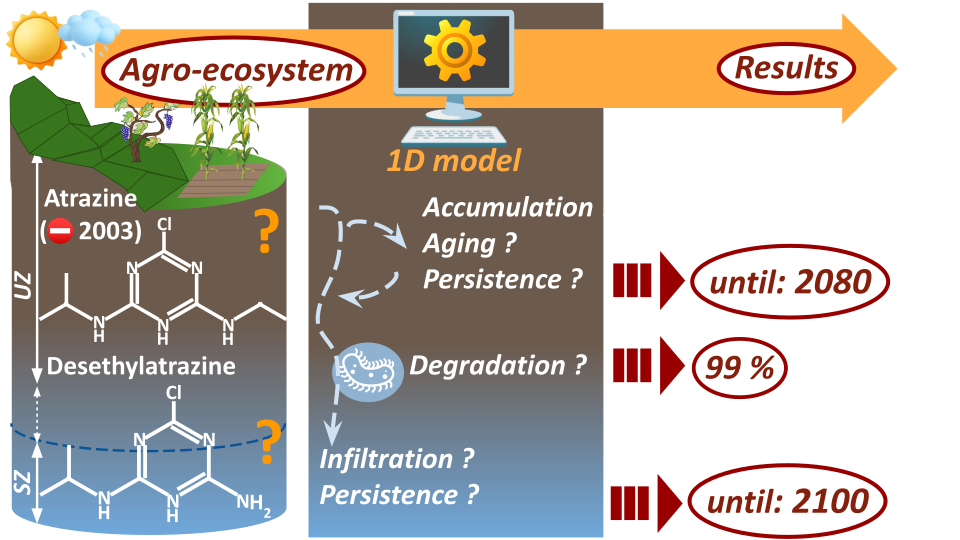
Safeguarding groundwater—a critical resource for drinking water—requires understanding the long-term environmental impact of agricultural pesticides. Before reaching aquifers, applied pesticides leach through the unsaturated zone (UZ), a dynamic subsurface layer that acts as both a natural filter and a biochemical reactor. Within this zone, pesticides degrade into Transformation Products (TPs) such as DEA, ESA, and TFA. These TPs are frequently more persistent, soluble, and mobile than their parent compounds, creating a "legacy contamination" that threatens water quality decades after specific chemicals (like Atrazine) are banned. For example, TFA, an emerging highly mobile TP, is currently detected in over 97% of monitoring sites in the Alsace aquifer. For environmental managers and policymakers, mitigating this pollution is severely hindered by complex seasonal river-aquifer interactions and the inherent limitations of traditional monitoring, which struggles to distinguish actual contaminant destruction (mass loss) from simple physical dilution. Addressing this knowledge gap is essential for developing evidence-based territorial water policies and securing long-term public health.
An Innovative, Operational Approach to Predicting Contaminant Fate
To overcome these challenges, this PhD project hypothesizes that coupling reactive transport modeling with Compound-Specific Isotope Analysis (CSIA)—a cutting-edge technique using molecular signatures to definitively isolate genuine degradation from dilution—can accurately predict contaminant behavior in the soil-groundwater continuum. The research is driven by three core objectives tailored for both scientific advancement and public utility: (1) reconstructing the long-term accumulation and dissipation of legacy and modern herbicides using isotopic insights and historical agricultural practices;
(2) quantifying vertical contaminant fluxes via a parsimonious, open-access 1D model specifically designed to provide public administrations with practical, operational risk-assessment tools; and
(3) validating these predictions in complex, real-world hydrological systems using advanced coupled models (CubicM, SWAT+, and Feflow) backed by laboratory soil-column experiments.
By translating complex reactive transfer mechanisms into accessible, predictive models, this research proposes new tools for both the scientific community and public authorities to monitor water quality, manage contamination risks, and guide sustainable environmental policies.
The thesis combines empirical observation with modelling, focusing on the spatial variability of natural attenuation and accumulation processes in UZ across different drinking water protected area (Sélestat study) and the temporal dynamics of transport and transformation of pesticide transformation products throughout the UZ of a crop agro-ecosystem (Lampertheim, 67) connected to an agricultural catchment area (Souffel, France (67); 115 km2).