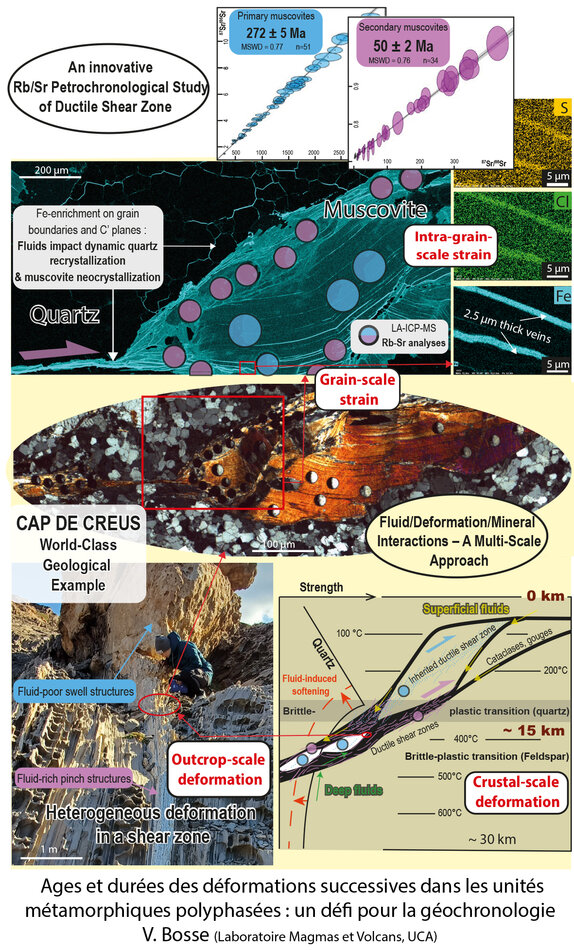
Timing and duration of successive deformation events in poly-orogenic metamorphic units: challenges for geochronology
Assessing the age, timescale, and duration of successive high- to low-grade metamorphic and tectonic events in ductile shear zones is crucial for understanding rift and orogenic processes and the mechanical behaviour of the lithosphere. However, it is a challenging task for geochronology due to the wide range of processes occurring under varying pressure-temperature-fluid (P-T-f) conditions, as well as the coexistence of mineral assemblages from distinct generations. The complexity is even more aggravated by the polyphase nature of lithospheric-scale shear zones, which are often reactivated during successive orogenic cycles. To effectively integrate geochronological data into geodynamic models, it is therefore essential to correlate them with other geological information (structural, textural, geochemical) and tie them to specific P-T conditions. Interpreting geological dates is inherently complex, as evidenced by the increasing number of published ages, sometimes leading to contradictory geodynamic interpretations. Only by clarifying our approach to geochronological data interpretation can we improve the accuracy and reliability of resulting tectonic models. Most metamorphic crustal rocks show an overprint of petrological events, with relict minerals coexisting with newly crystallized once. This raises a fundamental question: how can we assign a specific age to each mineral generation and link it to the tectono-metamorphic event responsible for its formation? In polyphase or polycyclic metamorphic domains, linking a deformation event to specific P-T conditions may be inconclusive when the observed fabric did not form contemporaneously. In such rocks, meaningful interpretation of an apparent age can only be achieved through detailed petrological and microstructural analysis, contextualizing the evolution of the chronometer within the history of the rock. In this presentation, we present case studies from different geodynamic settings that experienced polycyclic tectono-metamorphic evolution (e.g., Rhodope, Pyrenees, Armorican Massif) to discuss the challenges faced in obtaining and interpreting meaningful geochronological data.