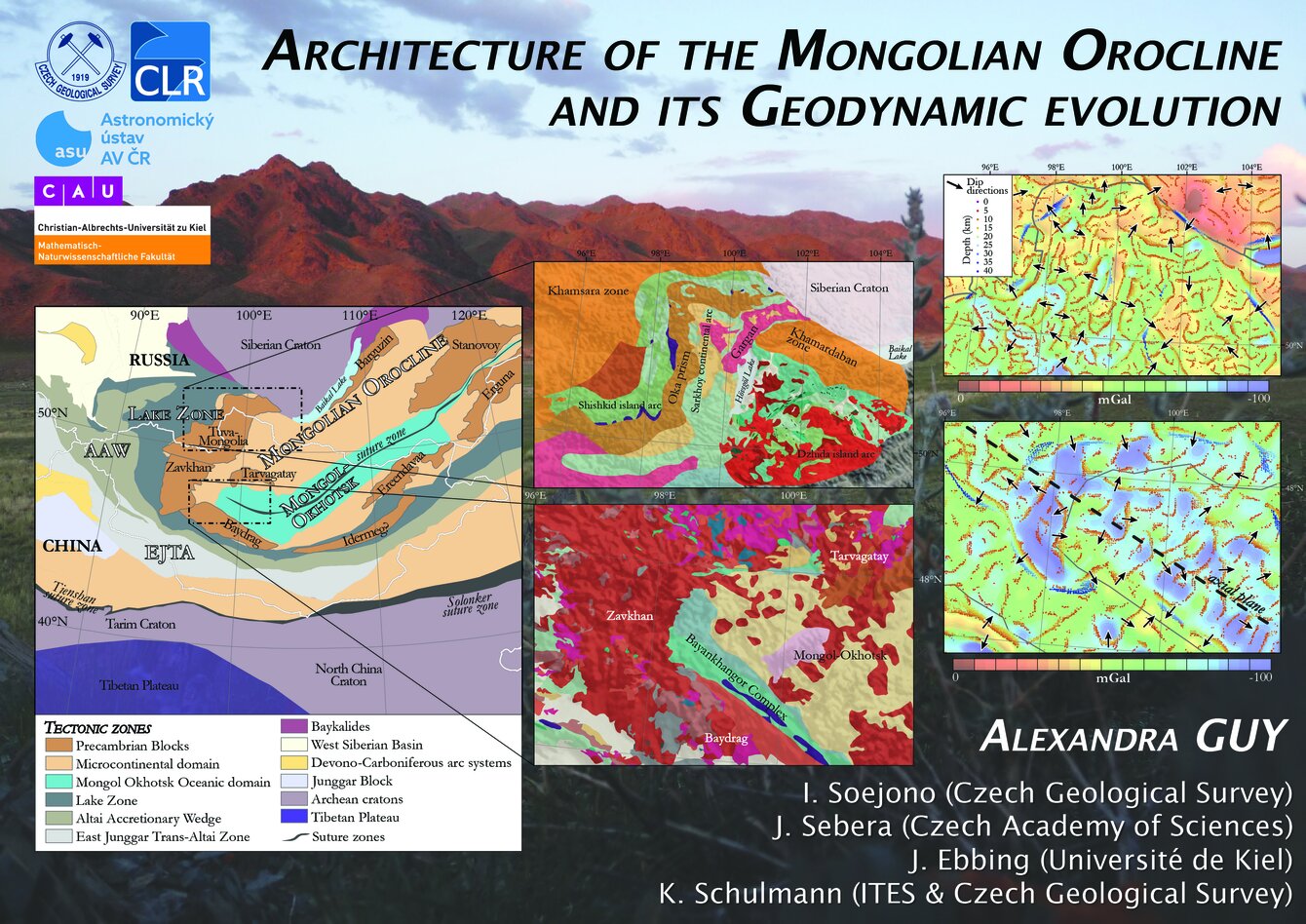
Architecture of the Mongolian Orocline and its geodynamic evolution
The tectonic architecture and origin of the Mongolian Orocline remain debated, particularly regarding the role of lithospheric-scale bending and the distribution of sutures within the Mongolian Collage of the Central Asian Orogenic Belt. By integrating geological observations,a synthesis of high-pressure metamorphic and arc-related magmatic rocks with magnetic and gravity datasets, we investigate the deep structure and tectonic evolution of this large-scale curvature.
Multiscale edge detection applied to potential field data reveals systematic lineament patterns and contact geometries across the continental and oceanic domains, defining a distinct U-shaped geometry. This geometry corresponds to a belt of high-amplitude magnetic and gravity anomalies associated with Precambrian continental blocks wrapping the Mongol-Okhotsk oceanic domain. The distribution and orientation of geophysical fabrics show coherent changes in strike and dip across the orocline’s northern limb, hinge, and southern limb, consistent with large-scale isoclinal folding accompanied by regional shortening. Magnetic and gravity data analyses indicate that some tectonic contacts extend to depths of ~40 km, suggesting that the oroclinal bending affected the entire crust and possibly part of the lithospheric mantle.
Contrary to previous models proposing multiple sutures separating the Precambrian microcontinents, our combined geological and geophysical evidence reveals no clear suture-related signatures between these blocks. Instead, they appear to form a single continental domain that underwent subsequent bending. The spatial distribution of high-pressure metamorphic rocks and arc-related magmatic complexes outlines two external continental scale sutures (the Mongol–West Sayan and Baikal–Sayan sutures) located along the orocline’s outer margins, and one internal suture zone along the northern boundary of the Mongol-Okhotsk domain. These observations support a model in which a near-linear continental ribbon surrounding the Mongol-Okhotsk oceanic domain underwent large-scale lithospheric bending during the late Paleozoic–Mesozoic. This study therefore suggests that the Mongolian Orocline represents the lithospheric-scale curvature of a formerly continuous continental ribbon rather than an assembly of independent microcontinents separated by multiple sutures.