Nested Newton solver for multiphase multicomponent flow in porous media for CO2 storage & Highly anisotropic fractured grid generation for ground water flow
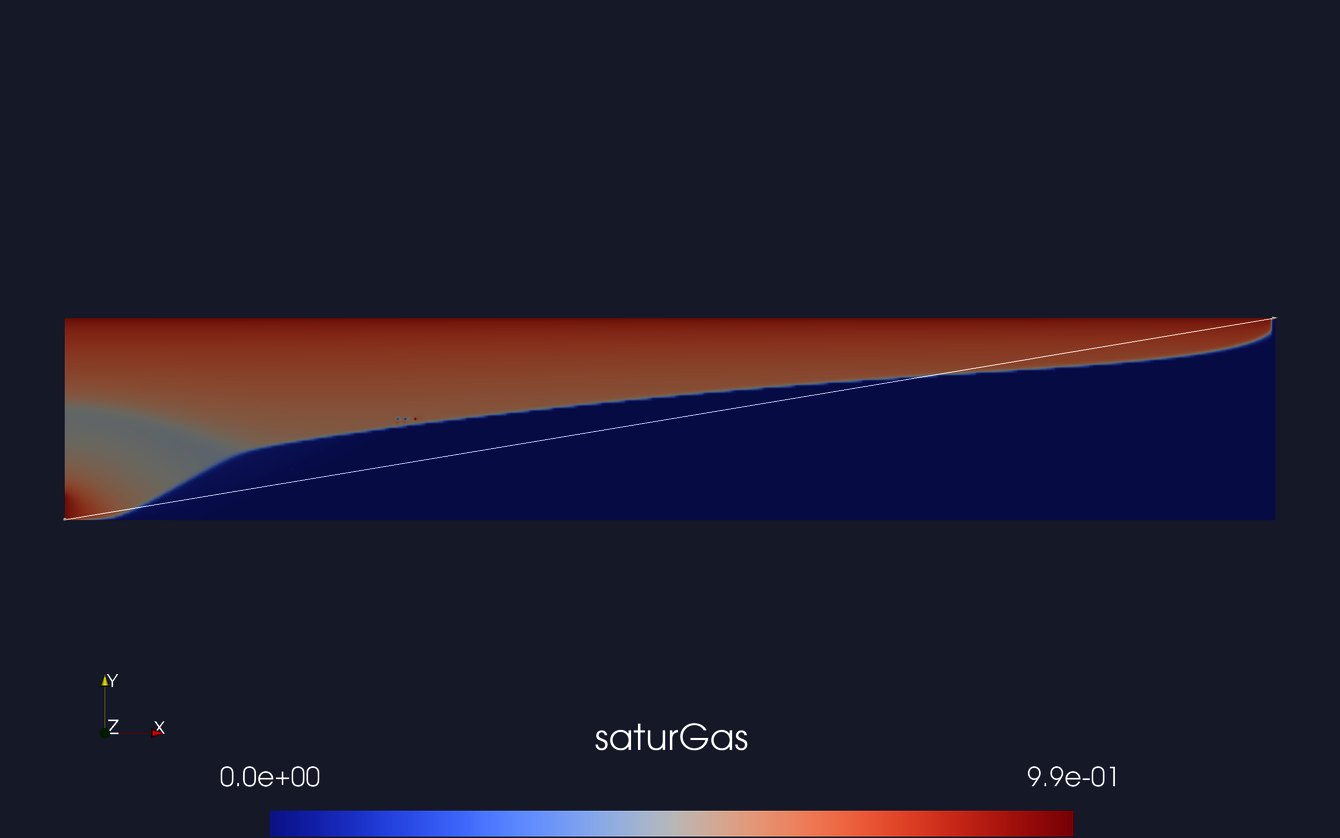
This seminar deals with two so far independent topics: A nested Newton solver for multiphase multicomponent flow in porous media with general reactions, and the generation of highly anisotropic grids for fully 3D expanded fractures to simulate ground water flow. 1.) In order to study the efficiency of the various forms of trapping including mineral trapping scenarios for CO2 storage behavior in deep layers of porous media, highly nonlinear coupled diffusion-advection-reaction partial differential equations (PDEs) including kinetic and equilibrium reactions modeling the miscible multiphase multicomponent flow have to be solved. We apply the globally fully implicit PDE reduction method (PRM) developed 2007 by Kr¨autle and Knabner for one-phase flow, which was extended 2019 to the case of two-phase flow with a pure gas in the study of Brunner and Knabner. We extend the method to the case of an arbitrary number of gases in gaseous phase, because CO2 is not the only gas that threats the climate, and usually is accompanied by other climate killing gases. The application of the PRM leads to an equation system consisting of PDEs, ordinary differential equations, and algebraic equations. The Finite Element discretized / Finite Volume stabilized equations are separated into a local and a global system but nevertheless coupled by the resolution function and evaluated with the aid of a nested Newton solver, so our solver is fully global implicit. For the phase disappearance, we use persistent variables which lead to a semismooth formulation that is solved with a semismooth Newton method. We present scenarios of the injection of a mixture of various gases into deep layers, we investigate phase change effects in the context of various gases, and study the mineral trapping effects of the storage technique. The technical framework also applies to other fields such as nuclear waste storage or oil recovery. 2.) Often, fractures have a major role within the transport of components within porous media. However, due to their complex geometric structure requiring anisotropic meshes, numerical computations are quite demanding when it comes to the interplay of the rock matrix and the mostly comparably very thin fractures. Sometimes, the aperture of the fracture is negligible compared to the surrounding matrix. However, there are effects which cannot be resolved by means of a low dimensional approach. A major bottleneck to allow for full dimensional computations of the transport phenomena in the fractures is the finite expansion of the fractures into the fully 3D space. This study presents the implementation of the ARTE algorithm to allow for highly unstructured grid generation with fractures. The application of the ARTE algorithm allows for an exact and valid finite expansion of the fractures into the 3D space. Work in progress is the computation of ground water flow upon such highly anisotropic fractured realistic networks in deep layers of porous media. Keywords: Globally implicit solver, PDE reduction method, nested Newton, equilibrium reactions, CO2, injection of various gases, porous media; ground water flow, automatic generation of finite expanded fractures in 3D, highly anisotropic unstructured grids.